



Geography
Our aim is to ensure KS5 students will be informed, engaged, and active global citizens who know and appreciate their role and place in the world. Geographers at Ashton Park will be able to identify the opportunities and challenges that face the world and evaluate solutions to help manage it. We want students to engage with this by investigating how the natural world works, how humans interact with the world, and the impacts they have on the environment. We want them to ask questions about the world and develop the range of skills needed to allow them to explore it in the classroom and beyond so wherever life takes them they can be confident global citizens.
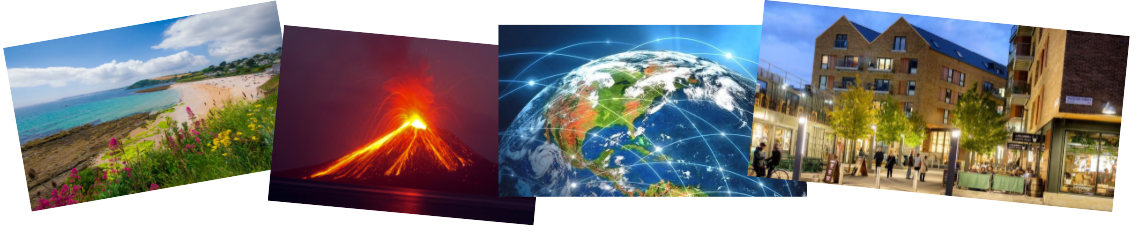
Please note we are currently changing the exam board we study in Geography so our current Year 12 and current Year 13 are studying different curriculums. Each of these is described below.
Curriculum for our current Year 12
Exam board for current cohort:
Number of assessments:
4 in total
- 1 x 2 hour 15 minutes Exam (Physical) (30%)
- 1 x 2 hour 15 minutes Exam (Human) (30%)
- 1 x 2 hour 15 minutes Exam (Synoptic Themes) (20%)
- NEA Independent Investigation 3000-4000 words (20%)
Our Year 12 curriculum:
| Teacher 1: Year 12 Physical Geography | Teacher 2: Year 12 Human Geography |
|
Term 1 and 2 Tectonic Hazards: Tectonic hazards – earthquakes, volcanic eruptions and secondary hazards such as tsunamis – represent a significant risk in some parts of the world. This is especially the case where active tectonic plate boundaries interact with areas of high population density and low levels of development. Resilience in these places can be low, and the interaction of physical systems with vulnerable populations can result in major disasters. An in-depth understanding of the causes of tectonic hazards is key to both increasing the degree to which they can be managed, and putting in place successful responses that can mitigate social and economic impacts and allow humans to adapt to hazard occurrence.
Term 3 and 4: Landscape Systems, Processes and Change: Coasts
Coastal landscapes develop due to the interaction of winds, waves and currents, as well as through the contribution of both terrestrial and offshore sources of sediment. These flows of energy and variations in sediment budgets interact with the prevailing geological and lithological characteristics of the coast to operate as coastal systems and produce distinctive coastal landscapes, including those in rocky, sandy and estuarine coastlines. These landscapes are increasingly threatened from physical processes and human activities, and there is a need for holistic and sustainable management of these areas in all the world’s coasts. Study must include examples of landscapes from inside and outside the UK.
Term 5 and 6 NEA |
Term 1 and 2 Globalisation: Globalisation and global interdependence continue to accelerate, resulting in changing opportunities for businesses and people. Inequalities are caused within and between countries as shifts in patterns of wealth occur. Cultural impacts on the identity of communities increase as flows of ideas, people and goods take place. Recognising that both tensions in communities and pressures on environments are likely, will help players implement sustainable solutions.
Term 3 and 4: Regenerating Places: Local places vary economically and socially with change driven by local, national and global processes. These processes include movements of people, capital, information and resources, making some places economically dynamic while other places appear to be marginalised. This creates and exacerbates considerable economic and social inequalities both between and within local areas. Urban and rural regeneration programmes involving a range of players involve both place making (regeneration) and place marketing (rebranding). Regeneration programmes impact variably on people both in terms of their lived experience of change and their perception and attachment to places. The relative success of regeneration and rebranding for individuals and groups depends on the extent to which lived experience, perceptions, and attachments to places are changed. Students should begin by studying the place in which they live or study in order to look at economic change and social inequalities. They will then put this local place in context in order to understand how regional, national, international and global influences have led to changes there. They should then study one further contrasting place through which they will develop their wider knowledge and understanding about how places change and are shaped. A local place may be a locality, a neighbourhood or a small community, either urban or rural.
Term 5 and 6 NEA |
Why is the course sequenced this way?
The course is structured in this way to allow students to see both Physical and Human Geography side by side. The difficulty of the topics increases through the year and then into year 13 with students tackling shorter questions in their first two topics to then be introduced to the longer 20 mark questions in their second human and physical topics. In Year 13 the topics use what they have learnt in Year 12 to improve their knowledge even further and establish synoptic links throughout the course.
How will I be assessed during the course?
- Regular exam questions in lessons to test your Geographical skills
- Short low stakes knowledge quizzes to test your knowledge
- Longer end of unit mock exams to consolidate everything we have done so far
Curriculum for our current Year 13
Exam board for current Year 13’s:
Number of assessments:
3 in total
- 1 x 2 hour 30 minutes Exam (Physical) (40%)
- 1 x 2 hour 30 minutes Exam (Human) (40%)
- NEA Independent Investigation 3000-4000 words (20%)
Our Year 13 curriculum
| Teacher 1: Year 13 Physical Geography | Teacher 2: Year 13 Human Geography |
|
Term 1-2 The Water Cycle and Water Insecurity Water plays a key role in supporting life on earth. The water cycle operates at a variety of spatial scales and also at short- and long-term timescales, from global to local. Physical processes control the circulation of water between the stores on land, in the oceans, in the cryosphere, and the atmosphere. Changes to the most important stores of water are a result of both physical and human processes. Water insecurity is becoming a global issue with serious consequences and there is a range of different approaches to managing water supply
Term 3-4 The Carbon Cycle and Energy Security A balanced carbon cycle is important in maintaining planetary health. The carbon cycle operates at a range of spatial scales and timescales, from seconds to millions of years. Physical processes control the movement of carbon between stores on land, the oceans and the atmosphere. Changes to the most important stores of carbon and carbon fluxes are a result of physical and human processes. Reliance on fossil fuels has caused significant changes to carbon stores and contributed to climate change resulting from anthropogenic carbon emissions. The water and carbon cycles and the role of feedback in and between the two cycles, provide a context for developing an understanding of climate change. Anthropogenic climate change poses a serious threat to the health of the planet. There is a range of adaptation and mitigation strategies that could be used, but for them to be successful they require global agreements as well as national actions.
Term 5 Revision for upcoming summer exams |
Term 1-2 Superpowers Superpowers can be developed by a number of characteristics. The pattern of dominance has changed over time. Superpowers and emerging superpowers have a very significant impact on the global economy, global politics and the environment. The spheres of influence between these powers are frequently contested, resulting in geopolitical implications.
Term 3-4: Migration, Identity and Sovereignty Globalisation involves movements of capital, goods and people. Tensions can result between the logic of globalisation, with its growing levels of environmental, social and economic interdependence among people, economies and nation states and the traditional definitions of national sovereignty and territorial integrity. International migration not only changes the ethnic composition of populations but also changes attitudes to national identity. At the same time, nationalist movements have grown in some places challenging dominant models of economic change and redefining ideas of national identity. Global governance has developed to manage a number of common global issues (environmental, social, political and economic) and has a mixed record in its success in dealing with them. It has promoted growth and political stability for some people in some places whilst not benefiting others. Unequal power relations have tended to lead to unequal environmental, social and economic outcomes.
Term 5 Revision for upcoming summer exams |
How will I be assessed during the course?
- Regular exam questions in lessons to test your Geographical skills
- Short low stakes knowledge quizzes to test your knowledge
- Longer end of unit mock exams to consolidate everything we have done so far